
One of my Republican friends frequently tells me, “I don’t trust government.” The Pew Research Center found that public trust in the federal government, which has been low for decades, has returned to near-record lows following a modest uptick in 2020 and 2021. Currently, fewer than two in ten Americans say they trust the government in Washington to do what is right “just about always” (1%) or “most of the time” (15%). This is among the lowest trust measures in nearly seven decades of polling. Last year, 20% said they trusted the government just about always or most of the time.
Approximately 75% of Americans believed that the federal government would act morally nearly always or most of the time when the National Election Study started collecting data on that topic in 1958. With the Vietnam War intensifying in the 1960s, the Watergate scandal, and worsening economic conditions in the 1970s, public confidence in the government started to erode. Before declining again in the mid-1990s, public trust in the government began to improve in the mid-1980s. But in the late 1990s, as the economy expanded, so did public trust in the government. After the 9/11 terrorist attacks, public trust immediately fell after reaching a three-decade high. Since 2007, the percentage of people who believe they can trust the government most of the time or always has not risen above 30%.
Today, 25% of Democrats and Democratic-leaning independents say they trust the federal government just about always or most of the time, compared with 8% of Republicans and Republican leaders. Democrats report slightly less trust in the federal government today than a year ago; Republicans’ views have been relatively unchanged.
Since the 1970s, trust in government has been consistently higher among members of the party that controls the White House than among the opposition party. Republicans have often been more reactive than Democrats to changes in political leadership, with Republicans expressing much lower levels of trust during Democratic presidencies; Democrats’ attitudes have tended to be somewhat more consistent, regardless of which party controls the White House. However, the GOP and Democratic shifts in attitudes from the end of Donald Trump’s presidency to the start of Joe Biden’s were roughly the same.
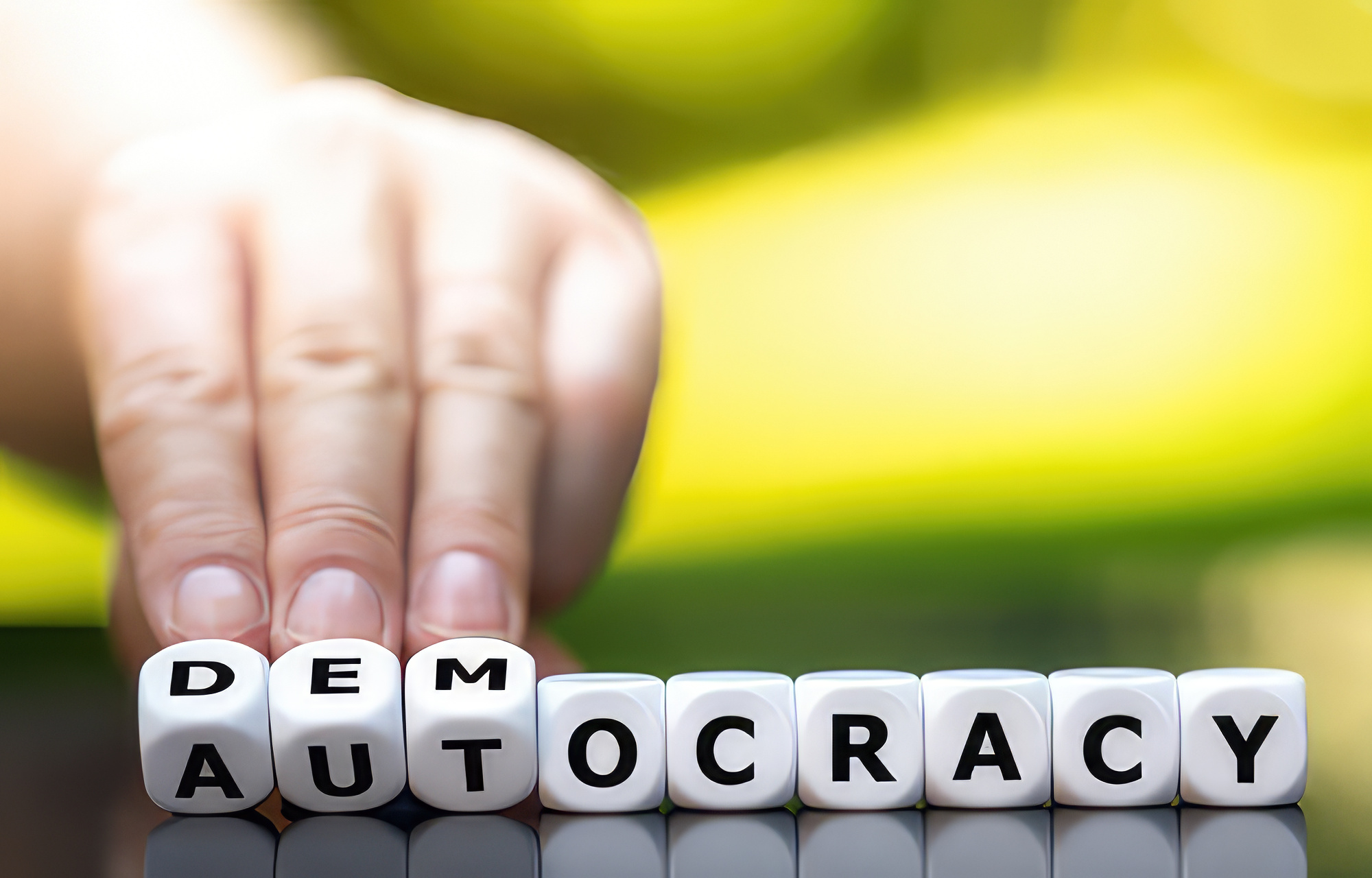
Certain frequently used words slip our tongues without us thinking about what they signify. Among these is the word democracy. It’s a word that describes a facet of society that we cherish yet frequently overlook. When authoritarianism, the opponent of this word, seems imminent, we can study this word’s definition more thoroughly. People tend to turn to the institutions meant to check authoritarian control, including the independence of the legal system and the press, when it threatens their society. In this nation, we cherish the idea of a constitution that routinely consults the people’s will. Depending on how well they believe a government can run the country, the public votes for or against it.
The concept of democracy is relatively recent. Throughout history and in most regions, alternative forms of government have been in place. Athens may have seen a brief flourishing of democracy in the 400s BC, but even there, its application was far from ideal. The assemblies of free citizens that made decisions were closed to women and enslaved people. In addition, the institution was insecure, and there was always a chance that autocracy would return. Greek terminologies describe many terms used to characterize the various political systems. Two have already been mentioned. Tyranny, theocracy, and oligarchy are some more examples. Latin terms like “emperor” and “dictator” are likewise acceptable. The political systems these phrases suggest have been dominant throughout history at various times. Among all the varieties, democracy was often only a theory. Usually, a strong individual would seize control of one of the state’s organs, like the army, and proclaim himself to be in charge. Dictatorship was occasionally used kindly. There was a time in the Roman Empire when Trajan, Hadrian, and Marcus Aurelius were the three succeeding emperors. Apart from these eighty years, from 100 to 180 AD, Rome’s history is characterized by a near-constant sequence of internal and external battles.
Nowadays, there are political upheavals in many nations. Some appear to be heading toward right-wing populist authoritarian political regimes. Regarding the United States, the Republican Party under Trump is making efforts to weaken the rule of law and the press’s position. The goal of impartial justice and oversight of the US Constitution is not significantly advanced by appointing an overtly political justice to the nation’s top court. Many evangelical Christians are in favor of the US’s attempts to veer closer to what is known as tyranny or authoritarian ruling. It seems that a lot of conservative Christians believe that Trump’s administration would pave the way for theocracy, another type of government. People think that Donald Trump is the next King Cyrus. God is using him as his instrument to dominate the nation through his appointed delegates.
As an idea, theocracy has only been attempted in very few places in history. In summary, it is the belief that God’s law and will can be applied to a human society and will usher in some form of perfection. The idea of theocracy could be said to undergird the indescribable brutalities of ISIS in Iraq and Syria. In the West, it formed part of the idealism of the early English Puritan settlers who moved to New England in the 1620s. In both examples, it can be claimed that idealism was quickly translated into violence (albeit on different scales) as not everyone wanted to conform to leaders’ ideals. American theocratic ideals of today owe a great deal to R.J. Rushdoony’s works. He had an idea for a government in the 1960s that was based only on Old Testament law. A significant group of Pentecostal/Charismatic thinkers gathered into a network called the New Apostolic Reformation and adopted these concepts. Not many people in this nation know its political influence in the United States. As may be expected, Rusdoony and his later copyists are passionate about imposing severe penalties on individuals who violate sexual norms, including the death penalty for bestiality and homosexuality. The “Seven Mountains” theory is one example of a modern manifestation. Accordingly, Christians govern society’s seven spheres of power on God’s behalf. In other words, “bible-believing” Christians ought to oversee all manifestations of culture and authority.
Theocracy as a practical system of government has probably not been worked out entirely, even by its enthusiastic supporters. But it still exists in the minds of many Trump Christian supporters as a political system that can be realistically implemented in the States. The critical (and scary) thing is that Rushdoony has led them to believe that the Bible is an adequate basis for all decisions of government. Men of God (it will only be men) will arise to rule on behalf of God. Because they are the genuine servants of the living God, they will be faithful interpreters of his will. Whatever they command in his name will perfectly express God’s law.
It is hard to see how any contemporary theocracy could perform any better than its historical models, which included Massachusetts in the 17th century or areas of Iraq and Syria under ISIS control. Force and terror are the only ways one can compel everyone to follow an “infallible” leader who proclaims the word of God. Large groups occasionally voluntarily follow a leader on a political or spiritual journey. However, there will always be skeptics or doubters in the crowd. Our post-Enlightenment inclinations are all driven to uphold the moral and legal rights of the nonconformist. The idea of infallibility is unhelpful in politics and religion and has no bearing on the advancement of conscience freedom. Just like among Trump’s Republican supporters, conservative Christians have an unfounded and pointless desire for absolute certainty. Theocratic authority enforced by “godly” infallible leaders ultimately leads to tyranny, the eradication of freedom, and violence. In summary, theocracy is a pipe dream. The fallibilities of human nature will always plague it because it depends on human beings to implement it. Despite all its flaws, democracy is still the best form of government we can access.
I sincerely hope that Trumpism and the intended shift by his supporters toward theocratic political systems will only be a brief historical footnote. But we still need to confront and counteract the global appeal of this authoritarian ideology. Promoting tolerance, inclusivity, and the right to disagree with others is honorable. Some in the United States believe that theocracy is a challenge to the Christian faith and an opponent of freedom.
Returning to the lack of trust in government, consider how different the world would be if Hubert Humphrey (D) had won the presidency in 1968 instead of Richard Nixon (R); if Jimmy Carter (D) had retained the White House in 1980 instead of Ronald Reagan (R); if Michael Dukakis had won the 1984 presidency instead of George H. W. Bush; if Al Gore had won the presidency in 1988 instead of George W. Bush; and if Hilary Clinton had won in 2016 instead of Trump. This is not to say that Republicans are inadequate or incompetent, but they don’t do as well with the economy or foreign affairs as Democrats.
Listening to Trump talk about his plans for a second term should frighten everyone. He wants to be king and turn the country into his cash machine at everyone else’s expense. We will all be subject to his every whim during his reign while individual rights disappear.